
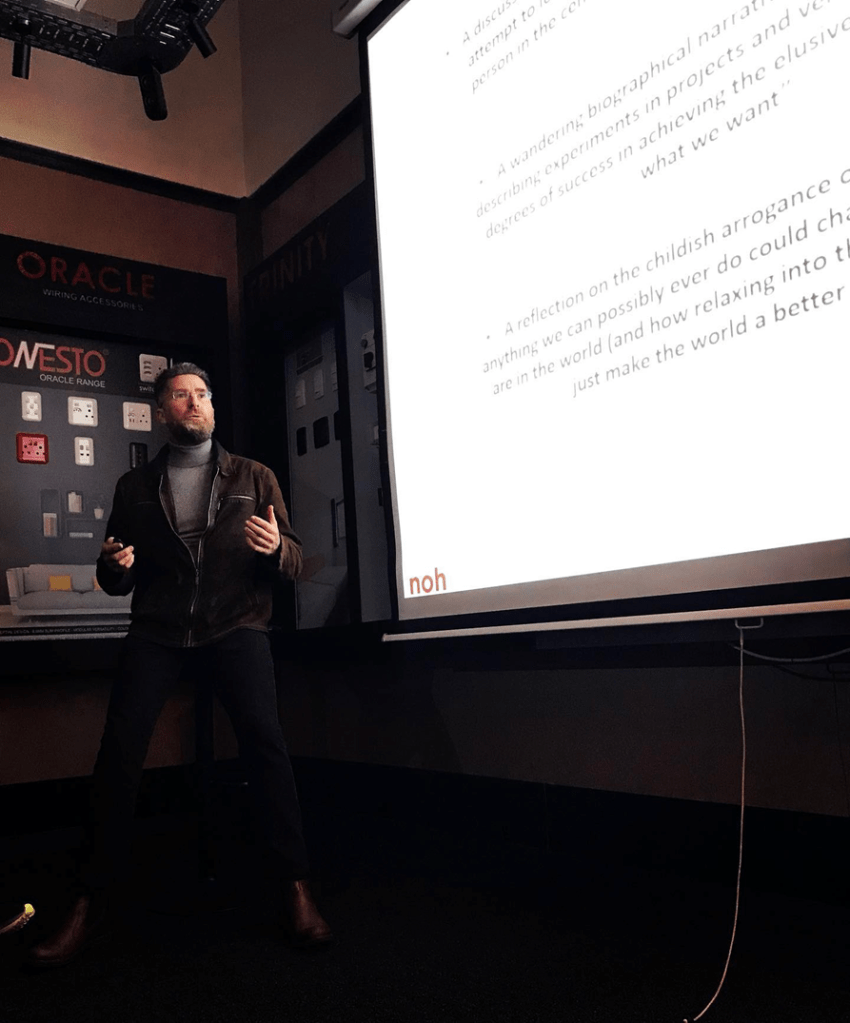
I like to spend as much time out at the university as possible. Though I’m a full-time practicing architect, but whenever they ask me to come out there to talk or to act as an examiner, I leap at the opportunity. Why? Because I think I’ve got something to give back, but also because it benefits me quite significantly through cross-pollination of ideas.
Last week I went out there. I gave a lecture to the students. They call it a “school lecture” Basically what a school lecture is at Nelson Mandela University Architecture School is where all five years gather together in one lecture venue: first year, second year, third year, fourth year, fifth year, and then the other technical diploma courses as well. And they invite an outside speaker to come and talk about something that is interesting and useful. So I spoke to the students about my experience with the Ubuntu precinct. The Ubuntu precinct is a project in Zwide that we’ve been involved with since 2008.
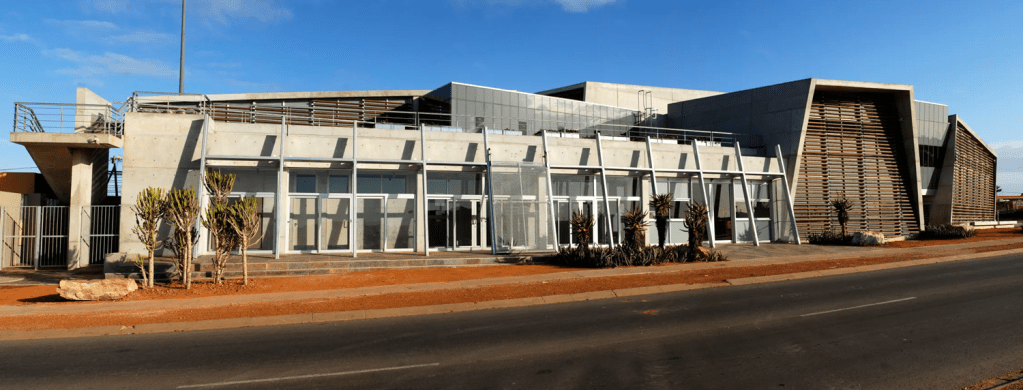
I very specifically spoke about the idea that no one person should be able to speak about a project because it’s always a team, and I’m very grateful that some of my team were there to listen to the talk. But the focus and the approach toward the talk was to speak about the Ubuntu Center as an example or a case study of private urban renewal as contrasted with public or state urban renewal. It’s an important distinction and an important phenomenon that we need to begin to observe because urban renewal is really such an important focus of what we have to confront in our country. Thirty years into democracy we still have this huge urban divide between rich and poor, between town and township, between the formal economy and the informal economy.
A lot of that is of course addressed by politicians, clever economists and developmental thinkers. But a lot of what needs to be spoken about has an urban context, an urban flavor to it, and architects are well placed to discuss and lead. In fact, I presented a paper in Seoul in 2017 at the World Congress of Architects, around the issues of the great divide, the gap between the wealthy and the poor, the wealth gap and the impact in our cities of our archaic land use rights regime that we have that entrenches this. I emphasized in that talk that architects have got a crucial voice to be heard and a crucial role to play. If architects are sitting back and hoping and believing that it’ll be town planners or civil engineers or even academics that will have a view on such crucial topics, they may be mistaken. Practicing architects especially, who confront the limitations and the constraints of land use rights every day and confront the challenges of urban renewal every day, really have got a voice to speak about how many limitations and controls stand in the way of developments even getting off the ground. Practicing architects know a lot about that.
But I want to speak about the Ubuntu project located in Zwide to the north of which we are right in the center of what was previously a black residential township area in terms of apartheid planning. It’s important that we speak about this because so much of what we see today in this area still very much resembles what you would have seen during the 70s and the 80s during the apartheid time. We must remember that apartheid planning is a conscious, deliberate bureaucratic and institutional attempt to order the city in a way that upholds the principles of racial divisions that were underlying the apartheid system of government. It had a very distinct and specific conceptual framework in which it divided the population not only between races—white, African, Indian, and coloured—but also very specifically allocated where business and economic activity would be allowed and tolerated and where there would be residential sprawl without business, without centers, without economic activity. Remember the attempt by the state at that time was not only to create a spatial racial divide but a business divide, an economic divide that favoured the white population. We are very much seeing even now the absolute power that that framework and structure was able to put in place so that even today we find our urban townships lacking in any significant commercial and industrial activity.
A lot of the work I have done in practice over the years has to do with public or “state” urban renewal. The examples of the work that we’ve done in Walmer Township funded by the Neighborhood Partnership Development Grant was trying to look at areas that are characterized by residential sprawl without business, without nodes, without corridors, and trying to identify and locate nodes and corridors of mixed use between private and public sector with the idea to “catalyze” private sector responses to those and develop centers of commerce, centers of industry, centers of activity in otherwise inactive and non-functional civic neighborhoods.
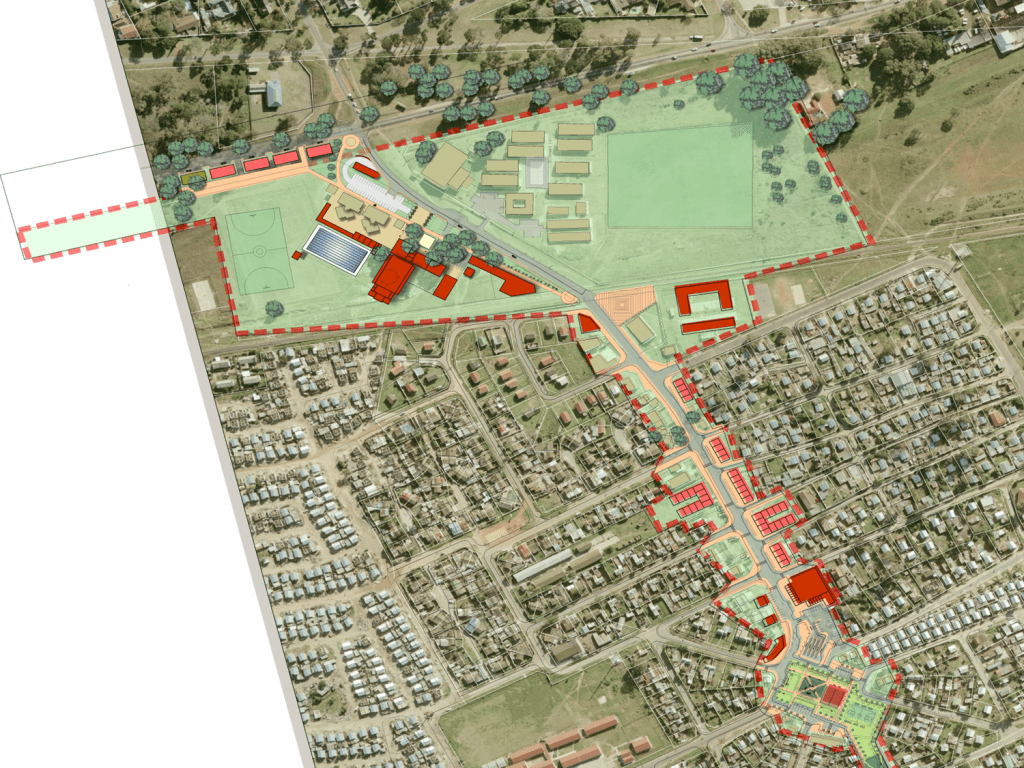
The work we did there at Fountain Road in Walmer Township was very interesting. It did identify one or two buildings that did in fact get built. There is also work that we were able to do in Rini Township in Makanda where the idea of taking a very poor neighborhood and identifying roads and corridors along those areas under very difficult community participation situations and then identifying places where there could be intervention for capital projects. The idea again, ws to spurring into life the economy of these township areas.
The Njoli Square precinct was another attempt, also a public state urban renewal attempt, to take an urban center and create a node out of it by injecting public transport infrastructure, by developing some sort of planning and framework where private and public investments could work alongside each other around the framework of what was already an informal sector trading hub with all kinds of related activities happening around there operating as some kind of a regional service center.
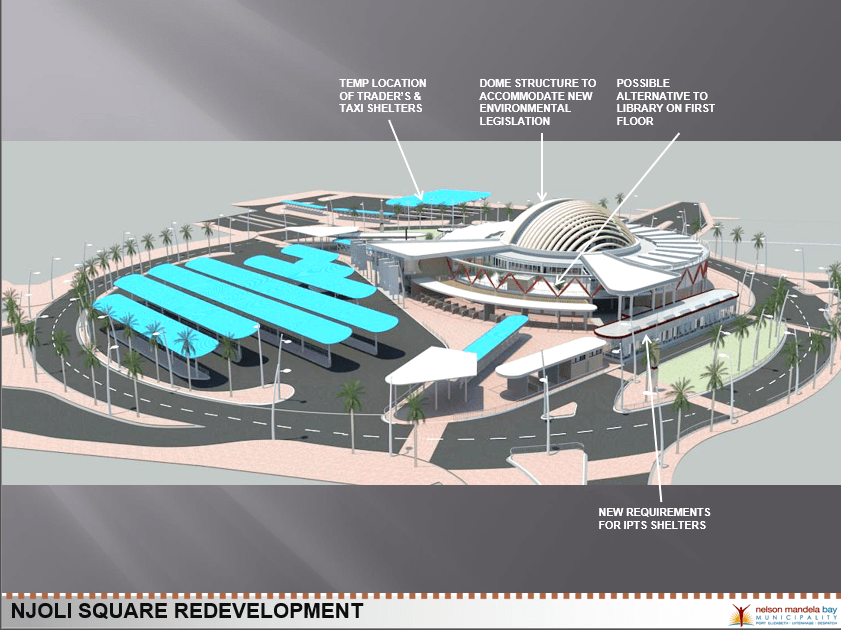
So the Nelson Mandela Metro, ran with this project over many years and really stumbled over its own feet with public participation and who knows what other obstacles we didn’t even know about that stopped the project from getting off the ground. In spite of there being funding in place, in spite of there being a significant amount of public participation, in spite of there being really quite thorough transportation and urban thinking integrated into the IPTS bus transit system, still it was a failure. On the ground now when you go there you see very little development, in spite of the fact that a number of private houses were flattened to make way for this project with money coming from the state to do that. So the Njoli Square project can only be described as a huge failure. Not a failure in developing a vision, not a failure in thinking, not a failure in the ability to get a budget allocated, but a failure in implementation. So there’s an example of public urban renewal, state urban renewal, really having significant limitations.
Korsten and Schauderville is another example caught up in very similar limitations. We worked there with the Mandela Bay Development Agency. Significant amounts of thinking was done in trying to transform this area again using the mechanism of nodes and corridors, trying to transform it into a functional, urban part of the metro. Significant amounts of public participation, great reporting, great design thinking, but resulting in almost zero implementation. Some of the projects we’ve worked on where urban renewal visions have resulted in buildings being built include work at Ntchekisa Road in New Brighton, work in Makanda, work in Walmer Township where some buildimg projects were completed.
But I want to speak not about the failures or the pitfalls that one finds with public urban renewal but rather focus on the example at Ubuntu in Zwide that is private urban renewal The approach is very different.
The way in which private urban renewal works is not the way that public urban renewal works. But I think we need to take serious note of this phenomenon. It is not very different to the phenomenon of private players becoming involved in dealing with what was otherwise a state responsibility in electricity generation, for example wind and solar, in communications where for years and years the post and telecommunications department was in charge of the telephone service and now it’s almost completely private with Vodacom and MTN and other players. Even private security: for years security was the realm of the state through the police force and now we have a significant private security industry. I’m not saying it’s good or bad. I’m just saying it is. And the question I pose is: Does the phenomenon of private urban renewal have a place in the future of South African cities?
The Ubuntu Centre in Zwide started simply as a funded operation providing health care, education, and teacher support in one small little building that was acquired in in the early 2000s by Jacob Lief and other co-founders in their non-profit. The program and the operations did so well that they expanded over the years and they built their first phase, a beautiful building designed by an American architect, Stanfield. NOH were invited in to support Stan Field with the technical and project management side of it, and that’s how we came to be involved in the project in 2008.
Beautiful award-winning buildings were built, unapologetically world-class design in an otherwise sprawling residential monotonous uneventful neighborhood. Right from the beginning design has driven the program. Beautiful spaces inside the hall and many of these places, if you visit them today, are pristine in this way.
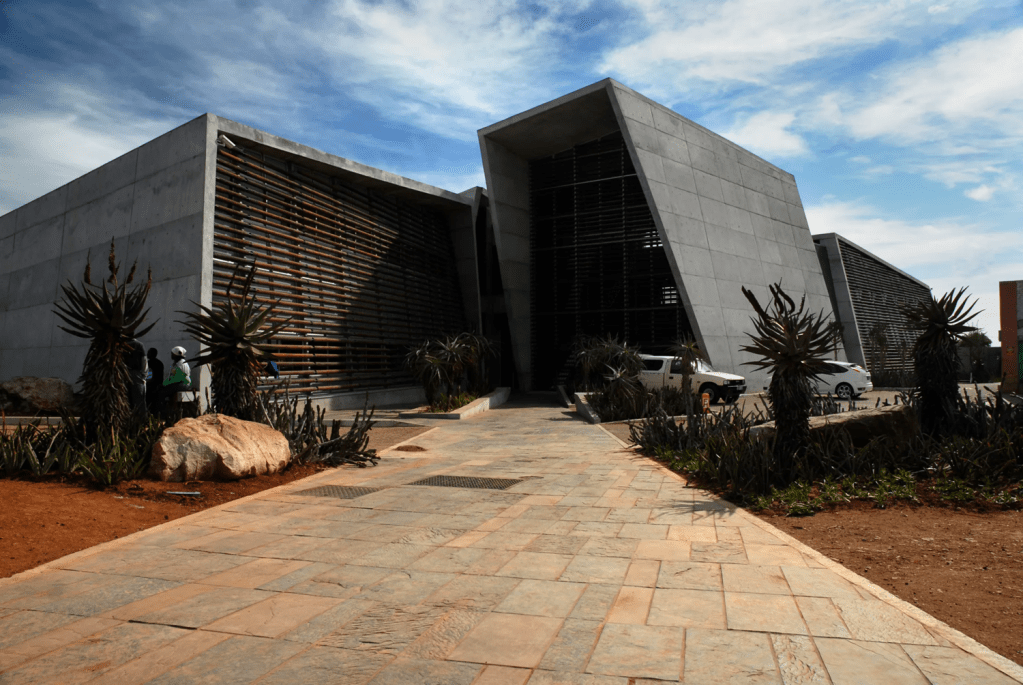
Well used and utilized but well looked after. These buildings exist in spite of a very hostile undeveloped public infrastructure environment. There are no walkways, very poor streets. The basics of water and electricity are there but only intermittently.
So we then became involved over the years firstly in assisting Ubuntu in the early years with adjusting their internal tenant layouts to adjust to their programs as they expanded over the years. Progress and change then led to a subsequent phase where the job skills training happened. By that time Stan Field was out of the picture and NOH Architects were working on that.
The way in which architects become involved in public or state urban renewal and the way in which they become involved in private urban renewal is very different. With public urban renewal there will ordinarily be some public process. There will be an advertisement and you’ll respond to a tender or you’ll address it in a very formal way with bids. With private projects the way in which I became involved in leading this current process through NOH Architects is one of networks. Stan Field approached John Rushmere asking for advice about how to get local support, project management and technical approval support. John explained that he was busy running a school of architecture but introduced him to John Blair. John Blair explained to Stan Field that he was approaching retirement but that he worked with Tim Hewitt-Coleman. John Blair had met me because I had gone into practice with Dr. Innocent Okpanum and Sindile Ngonyama in 1996, and because of being in practice with them I then met John Blair who introduced me to Stan Field. John and I worked for a number of years together with Stan Field and then just John and I and then just me leading the team.That’s very different to the way in which the appointment of an architect in the public urban renewal space would happen.
Public urban renewal happens very much from the need and then outward into the building and from the building then out into the public realm. It’s very different to the public renewal process which begins by putting together a huge vision and then tries to lobby for a budget from funding departments or national treasury and then goes back to attempting to implement something with whatever budget can be found. The private urban renewal process contrastingly, begins with needs and operations and from this process of needs we developed over the years some kind of master plan which sees phasing happening over a number of phases. Right now we’ve got eight phases under discussion of which the first four have been completed. The attempt always is to add to the great original design that Stan Field led with sensitive interventions. Urban renewal in the private sense involves everything from interior design to urban design and everything in between. “Vertical integration” may be one way to describe our approach to private urban renewal.
Some of the interiors of the operating Ubuntu Center and all of the details about introducing sustainable water systems, off-grid underground tanks, phasing in the primary school, developing our technology stack which includes cardboard models, Kokis, ink sketches, and the technology of concept harvesting where we collaborate as teams to bring forward the best ideas that would suit any objective. We use Revit as a software platform and also mark-up drawings using my stylus on my Samsung Note20 marking up PDFs while I’m driving or flying somewhere and sending them back to the office.
The junior phase was completed last year as part of the north campus. There are three different campuses: the north campus, the main campus on which the original build was done, and the south campus.
All of the work includes being on site and making sure everything is done exactly as it was meant to happen. This is of course a challenging task especially working in areas where there’s significant poverty. Everybody wants a job. Everybody wants part of the deal. Ubuntu has a fantastic way of dealing with this and making peace with where they are in the world with this kind of work.
We have completed our design for the high school on the north campus. We are continuously investigating different options and different fits and how this aligns not only with the site but with budgets that have been fundraised and with departmental approvals. The high school on the north campus is located on the north side. The junior phase we just finished construction on frames a courtyard. Because there is such a lack of urban renewal or because it’s a very hostile urban environment we emphasize the creation of soft internal spaces which protect from harsh external conditions, not only criminal elements which are real but environmental conditions like wind and dust.
Because land is at a premium here we need to treat it aggressively in terms of extracting everything out of the land use scheme to achieve the bulk required. So you end up with rooftop developments and basement parking to comply with municipal zoning schemes. A building newly acquired on the south campus by acquiring buildings that have become derelict over time will be renewed into an alternative site for the high school. Things move around and needs change. It now seems more likely that the high school will be developed on the south campus and the north campus may become an early childhood development center.
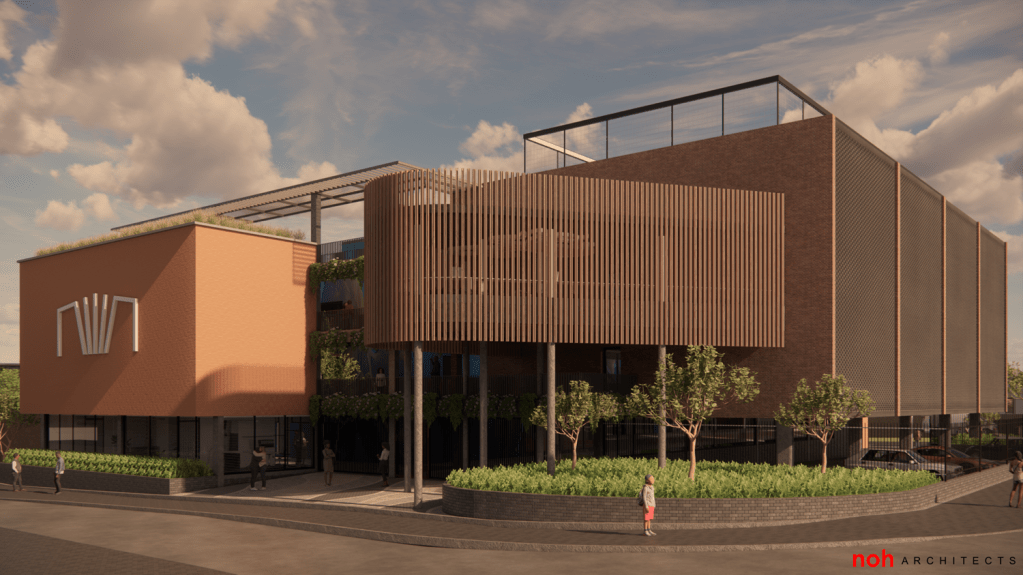
Ubuntu is always trying to acquire more land but the challenge is not to appear hostile in colonizing a neighborhood where people want to live. It’s a balancing act. Ubuntu has been waiting for years for the metro to upgrade the surrounding urban areas. Eventually they’ve given up and now Ubuntu is beginning to explore upgrading the public spaces in the road reserve around the campus at their own cost.
My feeling is that public urban renewal is something we need to think about carefully in the future. But there is not enough academic rigor applied to the question of what the difference is between public urban renewal and private urban renewal, when each should be used, what templates can be followed, and who has done it well.
If there are funding agencies and foundations that would like to become involved in this, it would really help if this way of doing things was documented and turned into some kind of guide. This is where universities should step in. To expect private practitioners like me to fly to Seoul and Korea and present papers out of the budgets that should be used to upgrade our offices is unrealistic. There needs to be a role that universities play in this.
 noh ARCHITECTS