Look after what we have got.

(I wrote this Column for the 9 April 2014 edition of Port Elizabeth’s daily newspaper, “THE HERALD”)
It was a windy, wet Wednesday. The sound of the angry sea crashing over the rocks was not even audible over the noise of the lone excavator as it crushed and smashed the last remains of what was the Seaview Hotel. Like a deranged beast, like an angry elephant, swinging left and right with its devastating mechanical trunk. The once gracious and manicured Minhetti was no more.
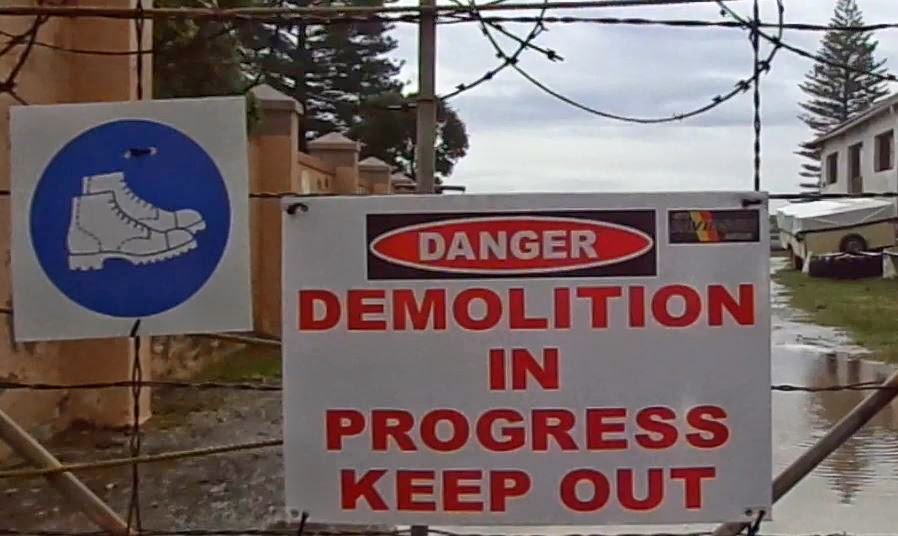
My son sat in the car, dry from the rain, as I stood by the gate, by the sign “Dangerous – Demolition in Progress”. I was not sad nor sentimental, not angry nor frustrated. I did not really even like the Seaview Hotel all that much the once or twice that I had been there. But I was filled with and uneasiness that stirred somewhere deep inside my innards. Over the course of my short life I have not yet been able to figure out what these deep feelings of uneasiness mean, or even whether they are of any significance. I have learned though, that it is normally I sign that I should step back and ponder. So here I sit, this morning, pondering over a fine Cappuccino in an average mall café.
I ponder over how we commit large amounts of energy into showing how frustrated “we” are that “they” demolished “our” hotel, or made potholes in “our” roads. Or how “they” built Greenacres, killing “our” beloved, historical Main Street. We know that it is too late, but still we commit the energy to raise our voice. Like the English complaining about the weather. Is this not a form of insanity? (Knowing nothing can come of our whinging, yet whinging anyhow!) But then I ask myself: ”If it is too late to save the Seaview Hotel, then what is it not too late for?”
I am sure each and every one of us has a best building or favourite neighbourhood, about which we are sentimental. But not each of us has a newspaper column in which to talk about it!
I do.
So, without any shame, I tell you: “Now is the time to take action to save Central, Port Elizabeth.” Framed by Govan Mbeki Avenue, the Baakens Valley, Rink Street and Russell Road, Central is home to the most extraordinary collection of rich and poor, young and old, sinner and saint. All framed in beautiful avenues, delightful squares, quaint lanes and irreplaceable buildings. How long will those of us that find meaning in Central wait before we find the energy to stand up, make a noise and take action? Will we wait for the last heritage cottage to be burned by damp and freezing vagrants? Will we wait for the last antique shop to flee to Walmer? Will we wait for the last coffee shop to tire of hastily hosing vagrant urine of its veranda every morning before the first customers arrive? Will we wait for the last office dweller to driven to Newton Park by the grime, dirt and continuous harassment by street people, drug dealers and petty thieves? When the last housewife, loses her last child in the hip high grass in any number of once perfect parks and playgrounds? Will it be after the bulldozers come, to clear the land, to flatten the monuments? Will it be then that we say “But how could “they” do this to “us”? How can “they” rob “us” of this enduring example of how city living can be tolerable, bearable and even enriching. How can “they” rob “us” of this model of authentic living that was our only contribution to the country’s emerging thinking on the future of the city?
I am sorry my friends, but I must offer to you that we are all delusional. Sadly we have come under the spell of a compelling lie, a myth that there exists such a thing as an “us” and a “them”. We can understand why the politically powerful may find it useful to perpetuate this myth, but it serves no purpose when we are needing to get things done. Right now, the thing that I am motivating, needs to get done, is that we save Central. If you are with me, then let us agree on one action we can take right now, as you put down this newspaper. Go find out more about the excellent initiative underway right now to establish a Special Rating Area (SRA) for Central (basically you pay a bit more rates to get better cleansing, security maintenance etc.)  It’s a “no brainer. SRA’s have been set up all over South Africa and the world.  Jo’burg’s got them. Richmond Hill has just set up an SRA, proving it can be done in our region.
If you do not live, work or invest in Central, all is not lost. Make a point of having a coffee in Parliament Street once a week. Make a point of buying an antique in Lawrence Street once a month, make a point of taking your kids to the Donkin Reserve once a term, make a point on attending a church service once a year in any one of the most beautiful Gothic revival churches. The point I make is, that our energy can be much better spent by expending it before the demolition than after the demolition.
Now that you are clear about what needs to be done: get out and do it! (Please)

Building Procedes

Well, quite a bit of work has been done on the cottage. I have a great team on the site headed by Gavin Fortuin and his colleague Roland. The gables have been repaired a new room has been prepared inside for the toilet and the floor of the living room has been excavated in preparation for the earthen floor. I met Diane on site on Thursday. She has made and earthen floor before. In fact she has built a cob house along William Moffat drive in Port Elizabeth. You can see it here.

Water for the works is still a big problem.

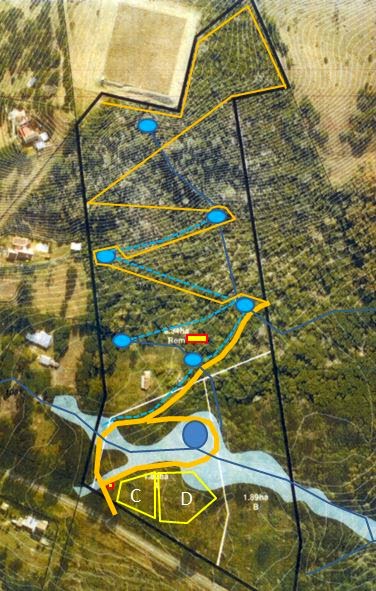
In the meantime we have moved the cattle over the stream to the grazing on the road side of the property.
The grazing is good there, but I was concerned to have them close to the road not trusting that they would not want to wonder off. The have been very well behave though since I put them there on Wednesday. I just moved them to a new patch of pasture this morning.

The NH bloody BRC

Got my “enrolment certificate” from the NHBRC today. (they took thirteen days to issue a certificate they promise on their website to issue in 24 hours) Took it straight to the bond registration attorneys. They promise to send it off to Cape Towns deeds office immediately. This should then take three weeks before the bond is registered and the property is ours. I cant think of anything that could still go wrong, but it has been such a long ride that I can believe that its almost done. Three more weeks!

In other News I made a firm offer to rend the 9 ha of overgrown bush to the east of us yesterday. I offered R21000.00 for 5 years and I offered to pay up front. The offer was well received but there is a meeting with the lawyers that will bring this matter to some conclusion.

Of Simplicity and Beauty

So, it’s Christmas Eve. If you are reading this you have probably survived the malls and the shopping chaos. You have probably spent more money than you had planned. You have probably bought a whole lot of stuff that you don’t really like for people who don’t really want more stuff. But this is our tradition, or rather this is what we have been lead to believe is our tradition. Even those of us who do not come from the land of snowy pine trees, jingle bells and basted turkeys have kind of begun to play along with the “season” and obediently do year after year what is expected of us.
Don’t get me wrong. I love the year-end break. I love floating in the pool, not shaving and pottering aimlessly around the backyard in those moth-eaten khaki shorts that my wife told me to throw out some time before the 1994 elections. But, when I am quiet with myself and think about it, I see that what I love most about Christmas holidays is that there is less “stuff”. There is less driving, less school, less work,  less email, less meetings and less clothing (at least in the backyard).
It is perhaps in this time that I slow down my mind enough to ask myself: “If having less makes me so happy, why do I spend so much of my life energy trying to get more? “ A curious question actually, and I am not sure that I can answer it for myself completely in my own life. But what I am more interested to talk to you about in this column today, is our cities and the buildings in them.  Because it seems to me that the ways in which we have complicated our lives with more and more stuff, is reflected back at us in the shape and form of our cities and buildings that grow more and more complex, less and less efficient and further and further away from the ideal of “natural beauty” that remains embedded somewhere deep inside each and every one of us.
So, what I am dwelling on in my mind these holidays is the question: “Can we find beauty in the process of simplifying our cities and the buildings in them?”.  For me, this quest for simplicity must be a one that understands the city as a living function whole; perhaps in the same way that the beauty of the flower or the butterfly comes out if the simplicity of the design solution as a response to the “whole”. The design of the honey bee colony seems to me to be the simplest, most efficient way of pollinating flowers while feeding honey to young bees. Therein lays its beauty. But our cities are not like this. Our buildings are not like this. Rather, they invent complexity. They reflect in-elegant clumsy solutions of our busy cluttered minds.
The most efficient and simple way to put bread on the table is surely not to be a worker in a giant bread factory in order to earn just enough wages to buy bread. The most efficient and simple way to deal with rainwater can surely not be to pay taxes to build a bureaucracy to run a massive storm water systems to lead perfectly good drinking water off our roofs through complicated concrete channels to the sea, while catching other rainwater deep in the mountains in expensive dams and piping it hundreds of kilometres right to your toilet where you flush it into yet another pipe that takes the water away again to be collected in one big smelly lake before being dumped again, in the sea.
No, of course it does not make sense. But we have become so tired from working so hard to accumulate more “stuff” that we have forgotten that it even had to make sense in the first place. But before you think that I am going on about bread making or water reticulation, I am not. I am asking myself for example: “ Is there a simpler more beautiful way to educate my children?”, “Is there a simpler more beautiful way to provide quality food for my family?”, “Is there a simpler more beautiful way to provide shelter for my family?” “Is there a simpler, more beautiful way to see to it that my family is clothed?”
The sad truth is that I, like you, know that there are simpler and more beautiful ways to do all these things. We also know therefore that there are simpler design solutions for the buildings and cities that must accommodated these things.
 I, like you know, that if we were to have the courage to change, we would be much happier people on a much healthier planet.
 But……where to find this courage? Perhaps it is here, in my backyard somewhere? Perhaps in the cool shade of the Avocado tree?

All that is “building” is not “Architecture”

This column first appeared in the
The Port Elizabeth Herald on 14 October 2013.

Last week Monday, 1October, was “World Architecture Day”. No; I did not do anything special either. I suppose I got distracted and caught up in all the excitement of World Yo-Yo day and the International Tennis Elbow Awareness week. You see, we live in a world where everything is important and Architecture has become one of those many, many important things. But, I wonder, is a world where everything is important not the same as a world where nothing is important? To be honest, I wasn’t even thinking about any of this on the evening of World Architecture Day. I was at home mending the hole in my backyard chicken house that the dogs had caused over the weekend while we were away. I did notice though, that the weaver birds had built the first nest of the spring in the Mulberry tree that overhangs my duckpond. The nest was well constructed, strong, resistant to wind and, I presume, quite dry inside. But, we know that the weaver bird’s nest is not “Architecture”. Animals can build, but only artists can create Architecture. Architecture is much more than just building, it is an art form. Architecture is a statement by a human mind about the mystical nature of beauty.

Two thousand years ago the roman Architect Vitruvius explained that for a building to be described as “Architecture” it must fulfil the requirements of “commodity, firmness and delight”. In other words, it is not good enough for a building simply to stand and to be functional. It must deliver “delight” to the users of the building. It must deliver “delight” in the same way that a great painting, or a great sculpture, or a great piece of music delivers “delight” to its audience. The difference with Architecture of course is that it is a functional, public art form that, in a very real way, touches the lives of the people that use it. But, the great advantage and significance of this art form is also its great weakness. Because, while those artists who paint with oil on canvas are left to do their own thing, Architects, are continually harassed by bureaucrats and salesmen claiming to be experts in “firmness” or “commodity”. The debate and discussion around “delight” and “what is beauty?” is largely abandoned in favour of arguments that can be supported by “measurables”: tangible things that can be quantified and counted. What strength of beam? What level of compaction below the surface bed? What length of escape to the fire exit?
But why, you may ask, am I even bothering you with this discussion? Is this not rather for Architects and Artists to discuss among themselves in coffee shops and libraries? I would say: “No! Absolutely not!”, because architecture, like other art forms, can only exist as art when it conects with the pubic that view it and use it. Great architecture needs great Architects, but only as much as it needs a public to appreciate it and powerful people to commission it.
Great architecture today, as always, happens only with the commitment and dedication of private sector investors, public sector developers and civic minded wealthy families. Very often individuals in these institutions make extraordinary sacrifices and take big risks in order to promote the idea of great architecture in an environment hostile to “outputs” that that which cannot be readily measured. An entire municipality or department of government can achieve a “clean audit” for ten years in a row without building one great piece of architecture. A property developer listed on the Johannesburg Stock Exchange can deliver excellent results for 20 years without building one great piece of Architecture. Wealthy families can show a much faster return on their money than by investing in great Architecture. Yet still, selfless individuals in these institutions, dedicated to the idea that there is more to this world what can be easily measured, have consistently seen to the implementation of great works of Architecture by great Architects. Because of this fact and in honour of these extraordinary people, every two years (for much of the 112 that the Eastern Cape Institute of Architects has been in existence), we pause to recognise and acknowledge great Architecture of our region. This process of acknowledgment culminates in an awards ceremony next week and a public exhibition of all the works of Architecture that put themselves forward for public scrutiny in the hope of receiving a much coveted “Award of Merit”.
This year the public are invited to view this exhibition of great work.  All of this happens in the dignified setting of the Port Elizabeth Opera House on 14, 15 and 16 October in an event called the “Urban Assembly”, which not only has three different exhibitions running simultaneously, but also has debates, speakers and activities running in the ornate and beautiful spaces that comprise africa’s oldest Opera House. This event seeks to elevate the discussion around the building of great Architecture and by extraction the building of great cities. It is for people that believe that we are able to transform the cities of our future and for people that know that, as a country and as a city we already have all the essential ingredients to build a great urban work of art in which we can all live our lives sustainably, efficiently and with the joy and pride that comes from being of a place that resonates with our contemporary culture.
Make a point of being there.
Tim Hewitt-Coleman 9 10 13