Searching for the real thing

(This piece first appeared in The Herald on 10 April 2013)

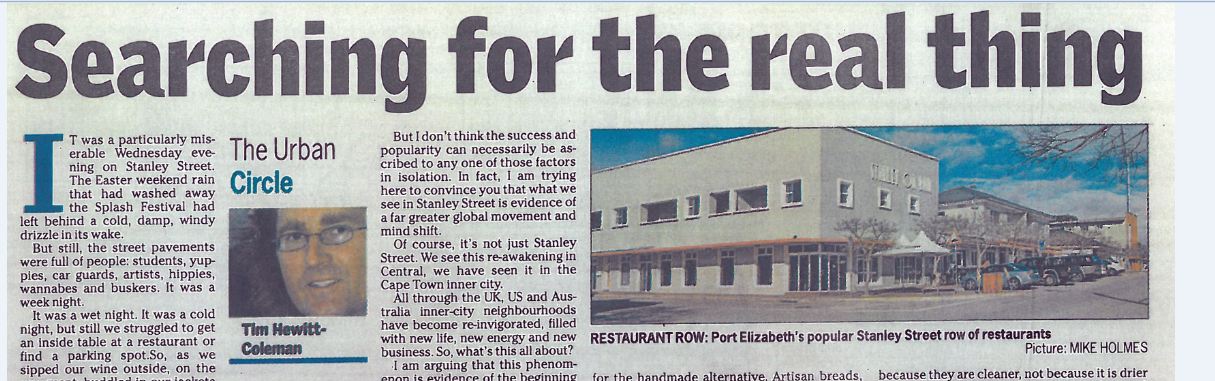
It was a particularly miserable Wednesday evening on Stanley Street. The Easter Weekend rain that had washed away the Splash festival had left behind a cold, damp windy drizzle in its wake. But still, the street pavements were full of people; students, yuppies, car guards, artists, hippies, wanabee’s and buskers. It was a week night. It was a wet night. It was a cold night, but still we struggled to get an inside table at a restaurant or find a parking spot.944907_10151899005068975_675733428_n
So, as I sipped my wine outside, on the pavement, huddled in my jacket against the wind, I could not help but wonder a little about why Stanley Street, in Richmond Hill, has become such a popular place to be. I mean, it’s nice, there are people walking up and down, quaint shops and restaurants, trees planted down each side of the street, but no evidence of any flamboyant spending. No dancing fountains, no Zara super store, no four storey high ice-rinked  atrium with glass lifts whizzing silently up and down. Why then, was I, like so many others, rather, instead, not enjoying climate controlled, 24 hour security, undercover parking,  porcelain tiled comfort of any number of malls, shopping centres or franchise eateries available for us to choose from on any given evening. Why was I abandoning comfort and security for this wobbly table on a windy sidewalk in an ageing part of town.  I am sure some would argue that Stanley Street’s popularity has to with the quality of its restaurants. Some would talk about accessibility; others still would guess that about the particular entrepreneurial vision of a key initial property investor.
But I don’t think the success and popularity can necessarily be ascribed to any one of those factors in isolation. In fact, I am trying here to convince you, that what we see in Stanley Street is evidence of a far greater global movement and mind shift. And, of course, it’s not just Stanley Street. We see this re-awakening in Central, we have seen it in the Cape Town inner-city. All through the UK, US and Australia inner-city neighborhoods have become re-invigorated filled with new life, new energy and new business. So, what’s this all about? I am arguing that this phenomenon,  is evidence of the beginning of a wider shift in consciousness which includes the wholesale rejection of all that is fake, a rejection falsehood, pretense and scam.  As mass manufacture, mass media and massive institutions private and public seek do dominate and control, we see beginnings of a backlash and a resistance.
Being continually bombarded by commercial messages and plots to extract money from us has left many cynical and jaded. Growing numbers of people no longer trust big business, big money and big institutions. These powerful “machines” make us stand in queues, they make us talk to their call centres, they keep making us change our passwords, they anger and frustrate us. This new cynicism has led to rush for antiques and collectables instead of cheap Chinese imports  and a rush to social media instead of American TV channels.  Those that still watch TV, watch “reality” TV choosing rather to watch the boring authentic lives of Big Brother housemates over the fake interesting lives of The A Team, Knightrider or the Brady Bunch. More and more people reject branded goods for the hand made alternative. Artisan breads, micro-breweries and a Barista crafting your Cappuccino just the way you like it.
Grassfed beef, whole milk, free range chicken and genuine leather are all part of this movement toward authenticity. Less and less do we tolerate artificial flavouring, dubbed movies or plastic Christmas trees. They are just not the real thing and are not good enough.
A growing number of people are searching for authenticity. People are searching for what is real, sincere and meaningful. For our cities, that means more and more people will come to reject remote suburban malls. More and more people will reject the franchise steakhouse with is standardised happy birthday clap along song and dance. The taste for the authentic drives these people away from the remote, sterile, cookie cutter secure complexes in Lorraine. This movement drives people away from insanely clean, manicured office parks where people live out their days in insanely sterile manicured office jobs.
In growing numbers, people choose Stanley Street and other inner city environs like it, not because they are cleaner, not because it is dryer or less windy, not because the pick pockets and drug dealers are banished, but because these environments feel real, they feel sincere and they feel authentic. These environments exhibit less evidence of heavy handed government planning controls that seek to sterilise and segregate. Houses in a houses zone. Shops in a shops zone and restaurants in a restaurant zone. Buildings neatly spaced out with nice lawn between them. No messy parking in the street. No people cluttering up the pavement. All very clean, but oh so boring and oh so fake.
Perhaps, what we see starting in Stanley Street and in Central can be the beginning of that “special something”  that Port Elizabeth and the Nelson Mandela Bay has to offer the world. PE can’t be more Joburg than Joburg. PE can’t be more Hollywood than Hollywood. PE can’t be more Vegas than Vegas, but PE can be the best in the world at being sincerely, authentically PE, the real thing!
Tim Hewitt-Coleman
PS: Please do me a favour;  subscribe to my newsletter its got some cool stuff!
Goedmoedsfontein

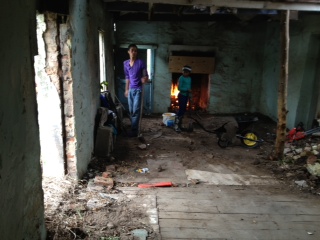
This weekend we have been cleaning up the rubble and debris inside the house. It’s slow going, but we have to be careful not to damage anything further than it is already.

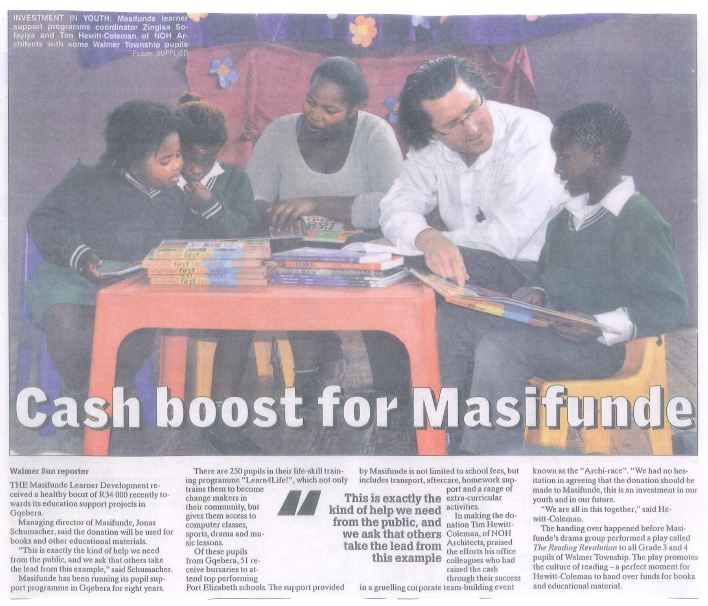
Last week, Tim officially handed over a donation of R34 000.00 to the Masifunde Education fund which operates in Gqebera. Tim explained to those at the function that his colleagues had raised the cash by participating in and winning a grueling sponsorored event known as the Archi race.

Central, Port Elizabeth – Blueprint for metro’s urban future?

I tend to go on a bit about the form and shape of our cities. I find myself speaking about better cities, greener cities and walkable neighbourhoods wherever I can and whenever I can. But, I have come to see that perhaps the idea of a new urban future is not so easy for most of us to visualise.
In a small meeting last week with very intelligent Phd’s, business champions and students of literature, a colleague and old friend confronted me: “What do you mean by “re-imagining the city”. Do you mean building winding streets rather than straight streets?” My friend could not see that changing the form of the city would have any impact on the lives of ordinary people. His frank question helped me see that the important work of building consensus on what our cities of the future should look like has not yet even begun. The ideas are there, but they are stuck in the minds, books and blogs of the brilliant few. The brilliant few however don’t build cities; they tend rather to spend most of their time arguing with each other.
I have decided to come to the aid of the brilliant few in attempting to build consensus. I have also come to see that looking back at our history exposes us to a laboratory of urban experiments, some that worked and some that did not. Looking in to the future on the other hand, is of course very confusing, untested and most of all; impossible.
I love Central Port Elizabeth.
I love the cool shade of Trinder Square. I love the antique shops of Lawrence Street. I love the galleries, museums and courthouses. I look through the grime and the vice to the underlying physical and spatial structure. Central is a living, breathing lesson in urbanism. It is a lesson from the past about how we can build the cities of our future. Let us consider Central for a minute:
·       Vibrant mix of Offices, residences and shops
·       Comfortable mix of old and young
·       Street life and café culture
·       Nightlife and youth culture
·       Rare mix of rich and poor
·       Healthy mix of rental and freehold
·       Hospitals, churches, schools, buses, taxis, shops and parks all in walking distance
I am not looking at Central as something that needs to be protected like a museum. I am pointing to Central as a contemporary model of urban land use, a model of mixed use and a model of car management that should be replicated throughout our metro, (or at very least along the corridors that now become supported by public transport)
Providing roads, sewer, water and electricity is cheaper in Central than in Sherwood or in NU5, because taller buildings and higher densities mean less infrastructure cost. Central has proportionately less streets to sweep and fewer bins to collect. We know that higher density environments are much more efficient for the public and private sector to service. About this there is no disagreement.
So, if Central is efficient, if Central is green, if Central is pro-poor, if Central is fun, if Central is beautiful, why can’t we see to it that we build more neighbourhood’s like Central?
The answer quite simply, ladies and gentlemen, lies in a very powerful little document called the “Port Elizabeth Zoning Scheme”. Authored in the 1960’s by nameless champions of suburbia and reworked and edited over the years by technical types seeking to close loopholes; The Port Elizabeth Zoning Scheme sets out what you may and may not do on your own property. It may allow you to work there, but not sleep there. It may allow you to pray there, but not shop there. It may compel you to build 10 m away from your boundary or it may compel you to provide hundreds of parking bays on your site for the shop you choose to build.
Central was designed before our contemporary obsession with the motor car. Central was designed at a time when walking was the dominant means of transport, (supported by public transport for longer distances). Central was designed at a time when we understood that it is illogical for each city dweller to plant a quarter acre of lawn in front of each of their homes. Suburbs like Newton Park or Kwadwesi will never become like Central because of the provisions of the Port Elizabeth Zoning Scheme (and other schemes like it). The Zoning Scheme requires that millions of Rands be thrown into parking basements, setbacks and building lines. The Zoning scheme encourages single use sterility. The Zoning scheme discourages mixing of rich and poor (you try build an affordable, Central style block of flats on your site in Walmer and see how far you get!)
I am not suggesting here that we abandon our tradition of orderly city building, but I do suggest that we do not continue to let our city be designed by a faceless, anonymous and hugely outdated rulebook. I put it to the readers of this column, that we must be clear when engaging the municipality. We want our city to look and feel like Central. If they have rules on their books that stand in the way of this then those rules are of no use to us.
We are fortunate to have Central. It is full of life, it is full of hope and it is full of lessons.

This column first appeared in The Herald, Port Elizabeth, 29 November 2012

Have you hugged your Architect today?

The East Cape Institute of Architects (ECIA) is proud to be associated with this Business Link publication. Our members are full of praise for the work that Business Link has done over the years to strengthen linkages between businesses in our region. We recognise this strength because the building of linkages has been at the heart of our organisation for over 100 years.
The ECIA was founded as the Port Elizabeth Society of Architects in 1900. It has since that time worked tirelessly to strengthen linkages between Architects in the region. The Institute has also championed the cause of strengthening linkages between the profession and the public as well as private sector developers who make use of our services in creating the built environment that we see around us in the City, that we have all made our home.
Central to our task, our mission and our mandate is building and re-enforcing of linkages with the world of design and ideas from beyond the City limits and beyond the borders of our country. The Institute of Architects has over the years unapologetically promoted excellence in design and construction. This it does through a number of programmes including Continuing Professional Development (CPD), awards programmes and publications. In spite of its smaller economy and in spite of its remoteness from the centres of power and commerce, the ECIA has consistently continued its culture of excellence and innovation. At this year’s national awards ceremony in Cape Town, the South African Institute of Architects (SAIA) presented four “Awards of Merit” and an “Award of Excellence” to projects from our City. (No other region in our province managed even one award!)
It is critical that therefore that I now make this point to business and civic leaders that are reading this publication:
Port Elizabeth Architects are of the highest order. We have been able to achieve this status because of the unwavering vision of local private and public sector leaders who over the last one hundred and eleven years have continued to entrust us with their most significant, most public and most visible investments. I speak for every member of the East Cape Institute of Architects when I say that we are deeply grateful to you and the space you have given us to assist you in building a lasting built environment of which residents of our City can be proud.
It is not incidental that we have in Port Elizabeth a multi-award winning architecture department at the Nelson Mandela Metropolitan University (NMMU). The relationship between practicing Architects at the ECIA and the professors, lecturers and students at the NMMU has always been a special one. We treasure this relationship because we know that the practice of architecture has as its foundation the centuries old scientific and cultural traditions of six continents over many epochs. We treasure this relationship also because of the innovation that the NMMU is able to provide in seeking answers to the challenge of the sustainable and green cities that will have to become our future.
So, I would ask that you take your time to look though the Directory of Architects listed in this publication. I can personally vouch for each and every one of them. Feel free to speak to an architect about your vision and your ideas for your property (architects love to chat and a glass of red wine tends to make them even chattier.) Yes we want to make money out of you, but we are also interested in being responsible members of the business community. We are an interesting lot! Invite us to talk to your Rotary Club or your AGM. We will go on about the “Ideal City”,“green buildings”, Ancient Egypt or rain water harvesting. I can guarantee you it will be interesting!
GIVE US A CALL!
(This Article first appeared in the Business Link  on 12 November 2012)

THC 24 10 12