
People often compare property investment unfavourably to the stock market. On average, they’re probably right — the JSE or the S&P 500 will outperform the average property portfolio over time. But here’s the thing: it’s never about averages. In property, the decisions are specific, they’re within your control, and a little knowledge can make an enormous difference to your outcome. That’s a conversation for another day.
Today I want to talk about a question I get asked surprisingly often — and one that more people should be asking before they pick up the phone to an architect.
Should I build, or should I buy?
Why I Ask the Question
By the time most people arrive in my office, they’ve already made up their minds. They want to build. And I understand that — there’s something deeply satisfying about the idea of creating exactly what you want, from scratch, on your terms.
But I always ask: have you thought carefully about whether you actually need to build? Because building is expensive, time-consuming, and genuinely complex. If you can achieve your objective by buying an existing property — or by buying and modifying one — that path is almost always faster, cheaper, and less painful.
So before we talk design, I want to talk about the decision.
Run the Numbers First
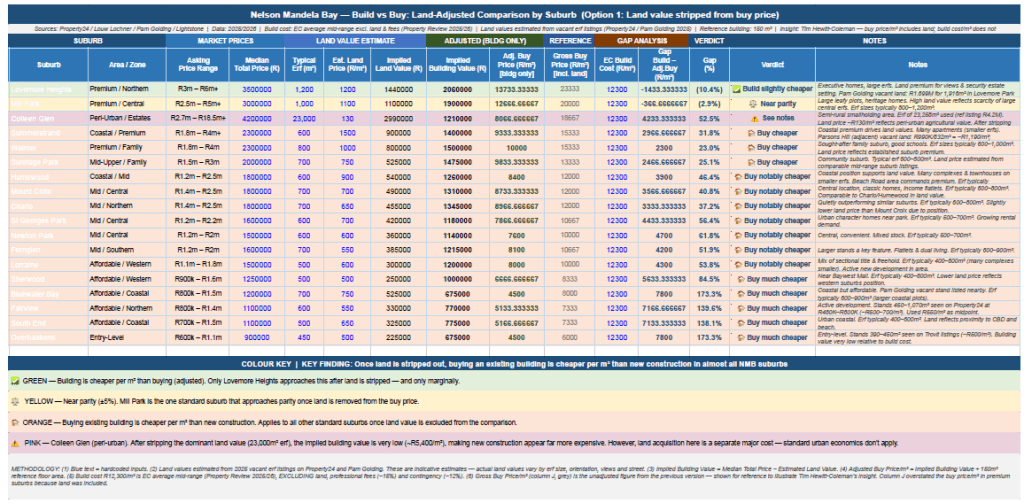
The first thing I suggest is a simple spreadsheet exercise. Look at what properties are selling for per square metre in the suburbs that interest you. Then look at what it costs to build per square metre in those same areas. The comparison will tell you a lot.
In some suburbs, building new makes reasonable financial sense. In others, you can buy existing property so far below replacement cost that building would be financially irrational. This isn’t complicated analysis — it just requires the discipline to do it before you get emotionally committed to a design.
Be Specific About Your Objective
Sometimes the numbers alone don’t settle the question, because your needs are specific. Let’s say you want a guest house within walking distance of the beach. You can’t compromise on location, and you can’t find an existing property that works. Fair enough — but even then, the question isn’t immediately “should I build?” It becomes: can I find vacant land here? Or can I find an existing property that I can adapt, at a cost lower than building from scratch?
The cost of adapting an existing building is almost always less than the cost of starting from nothing. Not always — but almost always.
You’re Buying Rights, Not Just Bricks
Here’s something that many buyers overlook: when you buy a property, you’re not just buying the physical structure. You’re buying the rights that come with it.
That might mean the right to operate a guest house, to build a block of flats, to develop student accommodation, or to subdivide the erf. Those rights may already be in place, or you may need to apply for them. Understanding what’s possible on a given property — and what isn’t — is a critical part of the decision.
This is where the Local Spatial Development Framework (LSDF) becomes useful. It’s the municipal planning document that sets out what can and can’t be developed in different parts of the city. It’s publicly available, it’s not that difficult to interpret with a little guidance, and it can save you from buying a property that simply can’t accommodate your vision.
The Bottom Line
Building is complicated. It’s also sometimes the right answer — when your needs are truly specific, when the numbers stack up, and when you go in with your eyes open.
But before you start sketching floor plans or briefing an architect, do the homework. Compare the cost of building versus buying in your target area. Be honest about whether an existing property could serve your needs. Understand the rights and restrictions that apply to any property you’re considering.
The critical decision point isn’t the design. It’s the question that comes before it: is it absolutely necessary to build at all?
If the answer is yes — then let’s talk. I’m here for that.
Tim Hewitt-Coleman
Director, noh ARCHITECTS
Gqeberha, Eastern Cape

