
By Tim Hewitt-Coleman | Director, noh Architects | http://www.noharchitects.com
I get asked this regularly — and I understand why. The terminology in architecture and town planning is genuinely confusing. What is a site development plan? How is it different from a building plan? How is it different from a concept plan? Let me explain.
What a Site Development Plan Actually Is
A site development plan — or SDP — is a planning tool. It is the device we use to test whether a parcel of land can carry what a developer wants to put on it. A shopping centre. A block of flats. A hotel. A mixed-use development. Before you spend money on a full architectural design and a detailed municipal building submission, the SDP allows you to check the fundamentals with the municipality, with a degree of certainty, at a relatively early stage of the process.
Think of it as the planning equivalent of a feasibility study — but with teeth. It’s a formal submission. It has legal standing. And it can give a developer the confidence to say: yes, go. Or it can stop a project in its tracks before anyone has spent serious money.
Where the Definition Comes From
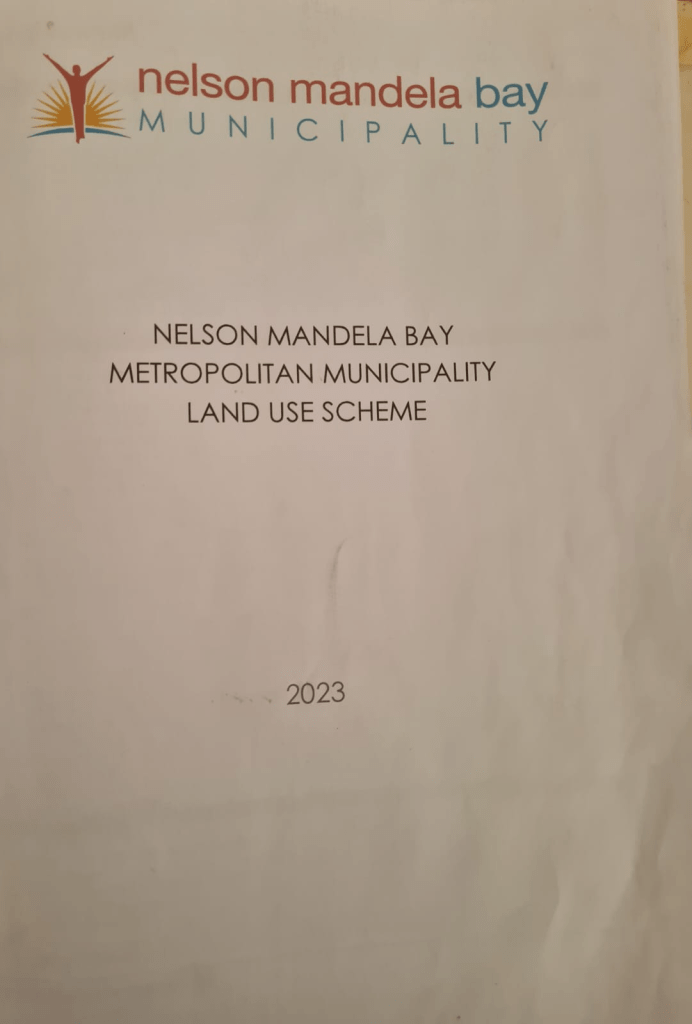
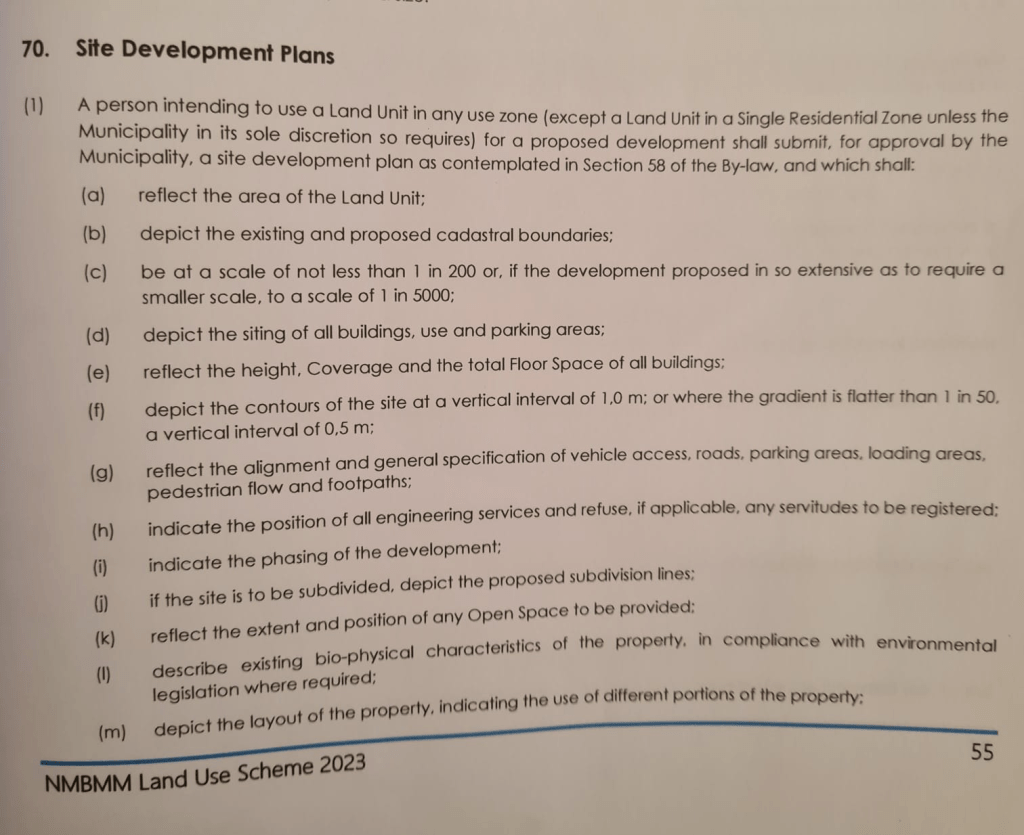
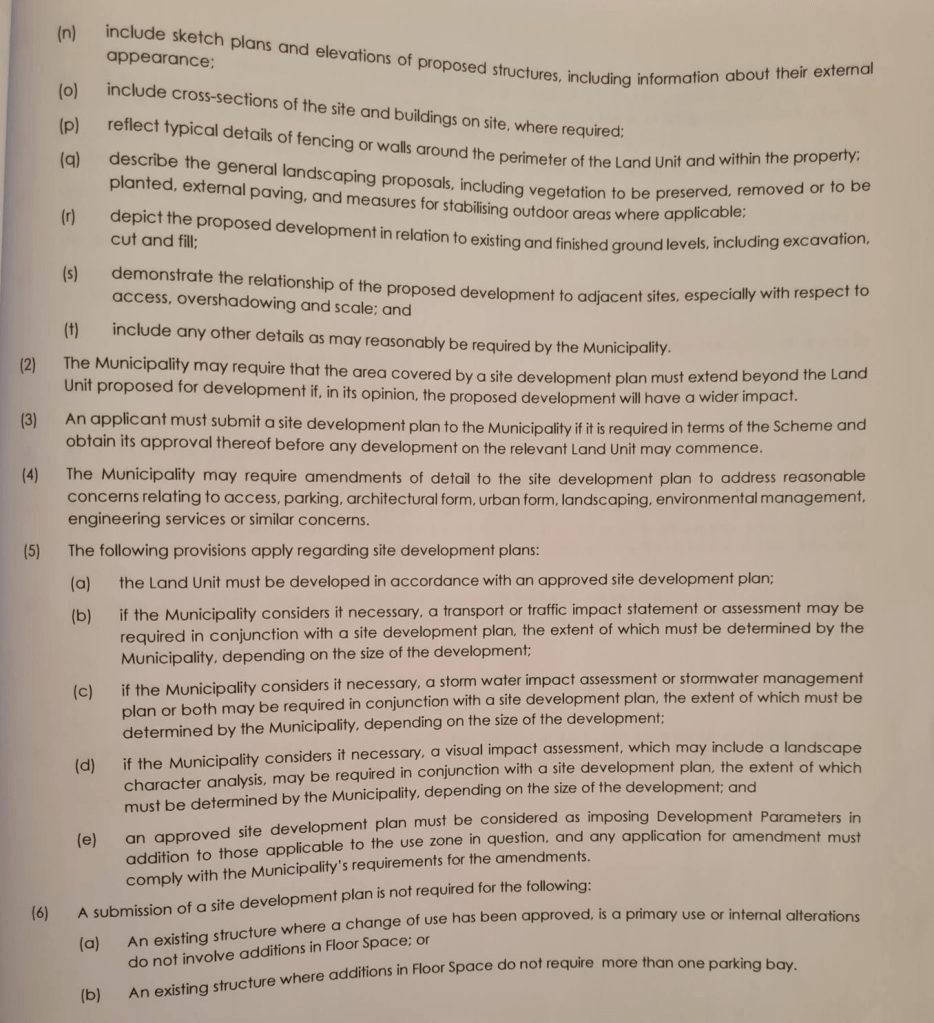
Don’t take my word for what a site development plan is. Go to the source. In Nelson Mandela Bay — and for most of the Eastern Cape — the authoritative document is the Nelson Mandela Bay Metropolitan Land Use Scheme of 2023. That is the zoning scheme. It defines the SDP, it sets out what must be included, and it tells you the scale, the required information, the supporting documentation, and the process.
If you’re working in another municipality, find your local zoning scheme. The definition will be there.
In the Nelson Mandela Bay scheme, the SDP definition appears at item 70, on page 55. Worth bookmarking.
What Goes Into a Site Development Plan
The SDP is not a full set of construction drawings. That’s the point. It is a drawing set that shows the land unit — the erf or erven — along with contours, proposed building footprints, parking layouts, access points, subdivisions where relevant, and other site-level information specified by the scheme. You are showing that the development concept fits on the land, complies with the applicable land use rights, and can accommodate the practical requirements of the site.
It saves you from the full effort of SANS 10400 compliance, drainage calculations, toilet schedules, and all the technical detail of a building plan submission — at least at this stage. That comes later. First, you establish that the concept is viable and approvable.
The Walking Sheet Process
Once you’ve compiled the SDP, you take it to the municipality’s planning department. They will issue you with a checklist and a document that we call a “walking sheet.” That walking sheet is your route map through the municipal system. You take your SDP drawings and your walking sheet to the fire department, to roads and storm water, to waste management — each relevant division of the metro. Each one reviews the proposal and signs off.
When all the signatures are in place, the municipality has confirmed that the proposed development is acceptable to each of those departments. That’s a significant thing. It means the developer has a green light — in principle — to proceed. A hundred two-bedroom units. Five thousand square metres of retail. The parking works. The storm water can be accommodated. Go.
Don’t Underestimate It
A word of caution: do not dismiss the SDP as a minor administrative step. It is not “just” a site development plan. It is a substantive piece of professional work. It requires careful analysis of the land use scheme, accurate site information, and a thorough understanding of the development proposal. Getting it wrong — or submitting something incomplete — costs time and money.
Done well, it gives a developer enormous confidence. Done poorly, it creates delay, uncertainty, and in some cases derails projects that could have been salvageable.
— Tim Hewitt-Coleman
If you are a developer, an investor, or someone sitting on a piece of land wondering whether your idea is viable — get an SDP done before you go further. It is the right tool for that question.

